
Overview
The Dallas-Fort Worth-Arlington metropolitan area, in north-central Texas, is coterminous with the Dallas-Fort Worth-Arlington, TX metropolitan statistical area and consists of Collin, Ellis, Johnson, Rockwall, Tarrant, Dallas, Denton, Hunt, Kaufman, Parker, and Wise counties. The principal city of Dallas-Fort Worth-Arlington is located in Dallas County. Dallas lies along the Trinity River near the junction of the river’s three forks, in a region of prairies, tree-lined creeks and rivers, and gentle hills. The metropolitan area is a center for economic drivers in defense, tourism, and film.
- As of July 1, 2025, the population of the Dallas-Fort Worth-Arlington metropolitan area was estimated at 8,477,200, an average annual increase of 159,775, or 2.1 percent, since April 1, 2020 (7,638,300) (Population Estimates, vintage 2025).
Fort Worth was originally a military outpost established in 1849.
Quick Facts About Dallas-Fort Worth-Arlington
Current sales market conditions: balanced
Current apartment market conditions: slightly soft
By Zoomprop Market Analytics · As of January 1, 2026
Economic Conditions
During the 3 months ending February 2026, nonfarm payrolls in the Dallas-Fort Worth-Arlington, TX metropolitan area totaled 4,327,450 jobs, an increase of 40,983 jobs, or 0.96 percent, from a year earlier.
- The unemployment rate was 3.9, up from 3.8 a year earlier.
- The Professional & Business Services sector led growth, increasing by 12,033 jobs, or 1.56 percent, to 782,500 jobs.
- The Dallas-Fort Worth-Arlington, TX metropolitan area accounted for 30.13 percent of all nonfarm payroll jobs in the state.
Nonfarm payrolls by sector — Dallas-Fort Worth-Arlington metropolitan area, the 3 months ending February 2026
| Sector | 3 months ending<br>February 2026 (jobs) | Year earlier (jobs) | Abs. Δ (jobs) | % Δ |
|---|---|---|---|---|
| Total Nonfarm Payrolls | 4,327,450 | 4,286,467 | +40,983 | 1.0% |
| Manufacturing | 311,950 | 313,967 | -2,017 | -0.6% |
| Trade, Transportation & Utilities | 903,950 | 900,733 | +3,217 | 0.4% |
| Information | 86,650 | 87,267 | -617 | -0.7% |
| Financial Activities | 390,750 | 387,333 | +3,417 | 0.9% |
| Professional & Business Services | 782,500 | 770,467 | +12,033 | 1.6% |
| Education & Health Services | 525,050 | 519,867 | +5,183 | 1.0% |
| Leisure & Hospitality | 425,650 | 422,233 | +3,417 | 0.8% |
| Other Services | 142,150 | 140,800 | +1,350 | 1.0% |
| Government | 493,000 | 486,033 | +6,967 | 1.4% |
| Unemployment Rate | 3.9% | 3.8% |
Numbers may not add to totals due to rounding. Source: U.S. Bureau of Labor Statistics (CES, LAUS). Rows marked † are reconstructed from QCEW county-level annual data, because the CES monthly series is suppressed or unpublished at this MSA; absolute YoY values are from the two most recent fully-published QCEW annual files.
Largest employers — Dallas-Fort Worth-Arlington metropolitan area
| Employer | Sector | Employees |
|---|---|---|
| AT&T | Professional & Business Services | 230,760 |
| American Airlines | Trade & Transportation | 102,700 |
| CBRE Group | Professional & Business Services | 100,000 |
Sources: local economic-development authorities, corporate filings, and press reporting (verified live at report-build time).
Sales Market Conditions
During 2026, home sales in the Dallas-Fort Worth-Arlington, TX metropolitan area totaled 9,293, down 62,223 home sales, or 84.7 percent, from 2025. Market conditions are balanced, with 5.9 months of supply and homes averaging 82 days on market during February 2026, compared with 71 days a year earlier.
- During 2026, new-home sales totaled 3,009, down 23,143, or 88.5 percent, from 26,152 in 2025.
- During 2026, existing-home sales totaled 6,284, down 41,081, or 86.7 percent, from 47,364 in 2025.
- The average sales price of a new home during 2026 was $475,692, up $179, or less than 0.1 percent, from $475,513 in 2025.
- Existing home prices closed 2026 at $414,656, down $11,325 or 2.7 percent from a year earlier.
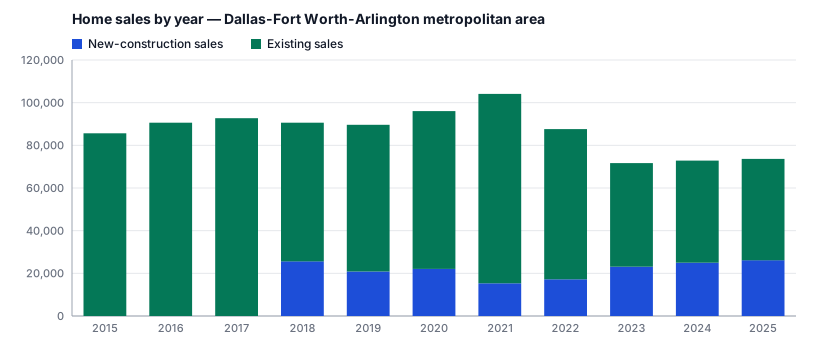
Home-sales totals — Dallas-Fort Worth-Arlington metropolitan area, annual
| Year | New-construction sales | Existing sales | Total |
|---|---|---|---|
| 2016 | — | 90,605 | 90,605 |
| 2017 | — | 92,703 | 92,703 |
| 2018 | 25,620 | 64,993 | 90,613 |
| 2019 | 20,837 | 68,788 | 89,625 |
| 2020 | 22,090 | 73,971 | 96,061 |
| 2021 | 15,306 | 88,797 | 104,103 |
| 2022 | 17,212 | 70,411 | 87,623 |
| 2023 | 23,105 | 48,550 | 71,655 |
| 2024 | 24,977 | 47,879 | 72,856 |
| 2025 | 26,152 | 47,364 | 73,516 |
| 2026 | 3,009 | 6,284 | 9,293 |
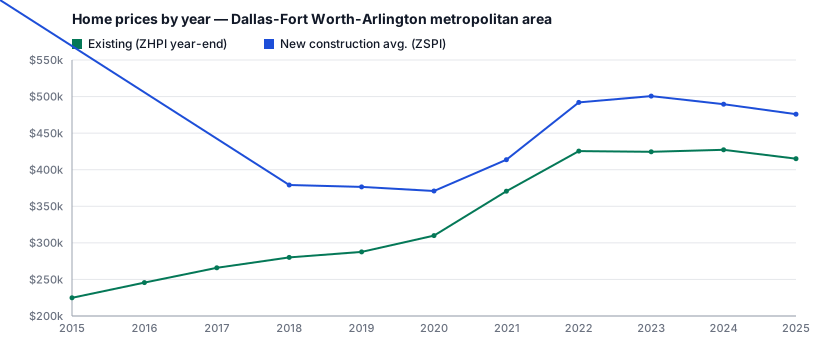
Average sale price — Dallas-Fort Worth-Arlington metropolitan area, annual
| Year | New-construction average | Existing (year-end) |
|---|---|---|
| 2018 | $379,142 | $280,085 |
| 2019 | $376,530 | $287,640 |
| 2020 | $370,894 | $309,871 |
| 2021 | $413,721 | $370,645 |
| 2022 | $492,049 | $425,433 |
| 2023 | $500,625 | $424,518 |
| 2024 | $489,582 | $427,263 |
| 2025 | $475,513 | $414,968 |
| 2026 | $475,692 | — |
Homebuilding and Permits
During 2025, residential building permits in the Dallas-Fort Worth-Arlington, TX metropolitan area totaled 65,181 units, down 6,970 units, or 9.7 percent, from 72,151 units in 2024.
- Single-family homes (1-unit structures) accounted for 39,230 permits during 2025, down 7,815 units, or 16.6 percent, from 47,045 a year earlier.
- Multifamily structures (5+ units) accounted for 24,213 permits during 2025, up 1,301 units, or 5.7 percent, from 22,912 a year earlier.
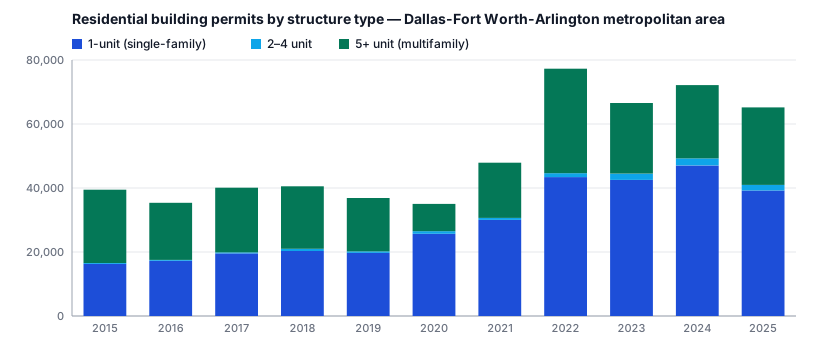
Residential permits — Dallas-Fort Worth-Arlington metropolitan area, annual
| Year | 1-unit (SF) | 2-4 unit | 5+ unit (MF) | Total |
|---|---|---|---|---|
| 2016 | 17,261 | 270 | 17,853 | 35,384 |
| 2017 | 19,565 | 307 | 20,223 | 40,095 |
| 2018 | 20,321 | 663 | 19,539 | 40,523 |
| 2019 | 19,727 | 468 | 16,677 | 36,872 |
| 2020 | 25,688 | 808 | 8,521 | 35,017 |
| 2021 | 30,019 | 629 | 17,253 | 47,901 |
| 2022 | 43,409 | 1,222 | 32,650 | 77,281 |
| 2023 | 42,543 | 1,940 | 22,074 | 66,557 |
| 2024 | 47,045 | 2,194 | 22,912 | 72,151 |
| 2025 | 39,230 | 1,738 | 24,213 | 65,181 |
Source: U.S. Census Bureau, Building Permits Survey (county year-to-date files, coYY12y.txt = full calendar year through December).
Apartment Market Conditions
As of the first quarter of 2026, apartment market conditions in the Dallas-Fort Worth-Arlington, TX metropolitan area are slightly soft, with an 9.0-percent vacancy rate as of February 2026.
- The average rent for all apartments in the Dallas-Fort Worth-Arlington, TX metropolitan area was $1,421 as of March 2026.
- HUD's FY2026 Fair Market Rents for the area are $918 for a one-bedroom unit and $1,205 for a two-bedroom unit. The two-bedroom FMR is 15.2-percent below the area's average market rent of $1,421.
- Recent developments include Amavi Celina with 271 units located in Celina, and Avendale Painted Tree with 276 units situated in McKinney.
Rents — Dallas-Fort Worth-Arlington metropolitan area, monthly
| Month | Overall rent | YoY change | Vacancy |
|---|---|---|---|
| 2026-02-01 | $1,416 | -2.1% | 9.0% |
| 2026-01-01 | $1,412 | -2.1% | 8.9% |
| 2025-12-01 | $1,413 | -2.3% | 8.9% |
| 2025-11-01 | $1,424 | -2.2% | 8.8% |
| 2025-10-01 | $1,439 | -1.9% | 8.7% |
| 2025-09-01 | $1,451 | -1.8% | 8.7% |
| 2025-08-01 | $1,455 | -2.0% | 8.7% |
| 2025-07-01 | $1,456 | -2.1% | 8.7% |
| 2025-06-01 | $1,455 | -2.0% | 8.6% |
| 2025-05-01 | $1,452 | -2.0% | 8.6% |
| 2025-04-01 | $1,445 | -2.2% | 8.6% |
| 2025-03-01 | $1,437 | -2.6% | 8.6% |
HUD Fair Market Rents — FY2026
| Bedrooms | 0 | 1 | 2 | 3 | 4 |
|---|---|---|---|---|---|
| Rent | $1,427 | $918 | $1,205 | $2,273 | $2,021 |
Source: HUD User FMR dataset (annual revision).
Location Fundamentals
The standard HUD HMP sections above describe the metropolitan area's housing market itself. This section characterizes the underlying drivers of price formation — safety, schools, natural-hazard exposure, infrastructure, policy, and demographic tailwinds — from Zoomprop's proprietary thematic layers. These signals are the most-replicated non-housing inputs in the hedonic-pricing literature.
The Dallas-Fort Worth-Arlington metropolitan area exhibits strong location fundamentals that are likely to influence home prices positively. The median school rating of 8.00 suggests a high quality of education, which is typically attractive to families and can drive demand for housing in the area. The top peril identified is hail, with a score of 94.26, indicating a significant risk that may affect insurance costs and property maintenance considerations. An average walk score of 47.0 reflects moderate accessibility, which can appeal to residents seeking convenience and connectivity. The area has experienced a robust three-year population growth rate of 14.2 percent, signaling increased demand for housing. Additionally, a three-year income growth rate of 20.1 percent suggests rising purchasing power among residents, which can further support home price appreciation.
Safety
- Across the Dallas-Fort Worth-Arlington metropolitan area, Zoomprop aggregated 248,919 reported incidents over the most recent six months and 39,410 in the last 30 days.
| Crime type | Last 30 days | Last 6 months |
|---|---|---|
| theft | 7,772 | 48,987 |
| assault | 4,981 | 31,042 |
| arrest | 4,909 | 28,521 |
| burglary | 3,147 | 20,965 |
| vandalism | 1,618 | 10,151 |
- Most recent FBI UCR data for the state (2025) shows a violent-crime offense rate of 17.6 per 100,000 residents and a property-crime offense rate of 91.9 per 100,000 residents.
Source: FBI Uniform Crime Reporting (UCR), state-level, latest full year available.
Schools
- 3,220 K-12 schools operate within the MSA (206 with GreatSchools ratings).
- Median GreatSchools rating is 8.0 out of 10; 104 schools score 8 or higher and 18 score 3 or lower.
- Average high-school graduation rate is 69.1 percent.
- Average student-to-teacher ratio is 14.6 to 1.
- Average share of students classified as low-income across schools in the MSA is 41.7 percent.
Top-rated schools in the Dallas-Fort Worth-Arlington metropolitan area
| School | City | District | GreatSchools | Grad. rate |
|---|---|---|---|---|
| Pioneer Heritage Middle | Frisco | Frisco Isd | 10.0 | — |
| Jim Spradley El | Frisco | Prosper Isd | 10.0 | — |
| Lawler Middle | Frisco | Frisco Isd | 10.0 | — |
| Vandeventer Middle | Frisco | Frisco Isd | 10.0 | — |
| Wester Middle | Frisco | Frisco Isd | 10.0 | — |
Natural-hazard exposure (FEMA National Risk Index)
- Of 1,704 census tracts in the MSA, 829 (49%) rated Relatively Low; 600 (35%) rated Relatively Moderate; 162 (10%) rated Relatively High; 109 (6%) rated Very Low; 4 (0%) rated Very High.
- Leading perils by average FEMA NRI risk score across the MSA's tracts: Hail (score 94.3); Heat Wave (score 85.4); Tornado (score 83.3); Cold Wave (score 67.6); Riverine Flood (score 49.0).
- The MSA's tracts average a social-vulnerability index of 50.2 and a community-resilience score of 21.0 (both on FEMA's 0-100 scale).
Source: FEMA National Risk Index, mapped to census tracts and rolled up to the MSA. Flood and wildfire capitalization into home prices is well-documented post-2017 disclosure (Bin & Polasky 2004; Keys & Mulder 2024).
Accessibility & infrastructure
- Across 128 neighborhoods measured, the Dallas-Fort Worth-Arlington metropolitan area has an average Walk Score of 47.0 and an average Bike Score of 42.1.
- 26 neighborhoods score above 70 on Walk Score ("very walkable"); 65 score below 50 ("car-dependent").
- The MSA is served by 9,212 public-transit stops operated by 4 transit agencies across 30 neighborhoods.
Demographic tailwinds
- Population-weighted median household income across the MSA is $83,913.
- Three-year median-income growth averages 20.1 percent.
- Three-year population growth averages 14.2 percent.
- Average neighborhood-level unemployment rate (ACS-derived) is 4.8 percent.
- Average ACS-reported median gross rent is $1,430.
- Average ACS-reported median owner-occupied home value is $275,143.
Terminology, Definitions, and Notes
Absorption. The net change, positive or negative, in the number of occupied units in a given geographic range.
Building permits. Residential building permits from the U.S. Census Bureau Building Permits Survey (BPS). Permit counts do not necessarily reflect all residential building activity; some units are constructed or created without a building permit, issued under a different permit type, or reported late. Annual totals are aggregated from the county-level full-year file coYY12y.txt (year-to-date through December).
Existing home sales. Includes regular resales and real estate owned (REO) sales.
Home sales / home sales prices. Includes single-family home, townhome, and condominium sales.
Net natural change. Resident births minus resident deaths.
Rental market / rental vacancy rate. Includes apartments and other rental units, such as single-family, multifamily, and mobile homes.
Data Lineage
- Employment (CES supersector): U.S. Bureau of Labor Statistics, BLS Public Data API v2.
- Employment fallback (QCEW county aggregation): U.S. Bureau of Labor Statistics, QCEW Open Data (CSV).
- Unemployment (LAUS): U.S. Bureau of Labor Statistics, LAUS series at MSA / state / national.
- Fair Market Rents: HUD User FMR dataset (ingested into
hud.fmr). - Mortgage rates, delinquency, state HPI: Federal Reserve Economic Data (FRED).
- Building permits: U.S. Census Bureau, Building Permits Survey (annual county files, live fetch).
- Population: U.S. Census Bureau, Population Estimates Program (PEP), vintage CBSA/metro flat files (
cbsa-estYYYY-alldata.csv) with April 1, 2020 decennial base. ACS 5-year estimates are used as a last-resort fallback only. - Narrative color (overview, largest employers, recent developments): Tavily research API, composed by GPT-4 with a fact-check pass against the structured payload.
Location Fundamentals data lineage (Zoomprop proprietary)
- Crime incidents (Zoomprop aggregates): rolled up from local law-enforcement feeds into
public_records.crime_aggregates(rolling 7d / 30d / 6-mo counts per neighborhood). - FBI UCR offense rates:
public_records.fbi_crime_data, state-level, sourced from the FBI Uniform Crime Reporting program. - Schools:
public_records.school, built from NCES Common Core of Data, state DOE files, and GreatSchools ratings. - Natural-hazard exposure:
public_records.weather_risk, mapped from the FEMA National Risk Index (census-tract grain) to the MSA. - Walkability / bikeability:
public_records.walkability(Walk Score / Bike Score per neighborhood). - Public transit:
public_records.transit_stop(GTFS feeds from local agencies, stop-level geometry). - Policy changes:
analysis.policy_changes, curated from municipal / county planning department disclosures. - Development pipeline:
analysis.development_pipeline, curated from permit disclosures, planning-board agendas, and publicly announced projects. - Neighborhood-level demographics:
market.region_demographics_v2, derived from American Community Survey 5-year estimates, population-weighted to the MSA.