
Overview
The Oklahoma City metropolitan area, in central Oklahoma, is coterminous with the Oklahoma City, OK metropolitan statistical area and consists of Canadian, Cleveland, Lincoln, Logan, Oklahoma, Grady, and McClain counties. The principal city of Oklahoma City is located in Oklahoma County. Oklahoma City, the capital and largest metropolitan area of Oklahoma, has a rich history that spans from a pioneer tent city to a thriving oil capital in under 120 years. The metropolitan area is a center for tourism and defense.
- As of July 1, 2025, the population of the Oklahoma City metropolitan area was estimated at 1,512,800, an average annual increase of 16,575, or 1.2 percent, since April 1, 2020 (1,425,700) (Population Estimates, vintage 2025).
The Oklahoma City metropolitan area is known as the Horse Show Capital of the World.
Quick Facts About Oklahoma City
Current sales market conditions: balanced
Current apartment market conditions: balanced
By Zoomprop Market Analytics · As of January 1, 2026
Economic Conditions
During the 3 months ending February 2026, nonfarm payrolls in the Oklahoma City, OK metropolitan area totaled 707,000 jobs, a decrease of 5,400 jobs, or 0.76 percent, from a year earlier.
- The unemployment rate was 3.85, up from 3.17 a year earlier.
- The Education & Health Services sector led growth, increasing by 3,283 jobs, or 2.71 percent, to 124,350 jobs.
- The Oklahoma City, OK metropolitan area accounted for 39.61 percent of all nonfarm payroll jobs in the state.
Nonfarm payrolls by sector — Oklahoma City metropolitan area, the 3 months ending February 2026
| Sector | 3 months ending<br>February 2026 (jobs) | Year earlier (jobs) | Abs. Δ (jobs) | % Δ |
|---|---|---|---|---|
| Total Nonfarm Payrolls | 707,000 | 712,400 | -5,400 | -0.8% |
| Mining & Logging | 9,900 | 10,267 | -367 | -3.6% |
| Construction | 34,850 | 34,567 | +283 | 0.8% |
| Manufacturing | 34,950 | 35,767 | -817 | -2.3% |
| Trade, Transportation & Utilities | 128,650 | 128,267 | +383 | 0.3% |
| Information | 6,500 | 6,400 | +100 | 1.6% |
| Financial Activities | 37,950 | 37,600 | +350 | 0.9% |
| Professional & Business Services | 92,400 | 94,000 | -1,600 | -1.7% |
| Education & Health Services | 124,350 | 121,067 | +3,283 | 2.7% |
| Leisure & Hospitality | 76,400 | 78,900 | -2,500 | -3.2% |
| Other Services | 31,300 | 30,533 | +767 | 2.5% |
| Government | 129,750 | 135,033 | -5,283 | -3.9% |
| Unemployment Rate | 3.8% | 3.2% |
Numbers may not add to totals due to rounding. Source: U.S. Bureau of Labor Statistics (CES, LAUS). Rows marked † are reconstructed from QCEW county-level annual data, because the CES monthly series is suppressed or unpublished at this MSA; absolute YoY values are from the two most recent fully-published QCEW annual files.
Largest employers — Oklahoma City metropolitan area
| Employer | Sector | Employees |
|---|---|---|
| State of Oklahoma | Government | 37,600 |
| Tinker Air Force Base | Government | 26,000 |
| INTEGRIS Health | Education & Health Services | 11,000 |
Sources: local economic-development authorities, corporate filings, and press reporting (verified live at report-build time).
Sales Market Conditions
During 2026, home sales in the Oklahoma City, OK metropolitan area totaled 2,529, down 17,714 home sales, or 87.5 percent, from 2025. Market conditions are balanced, with 5.2 months of supply and homes averaging 79 days on market during February 2026, compared with 71 days a year earlier.
- During 2026, new-home sales totaled 549, down 3,689, or 87.0 percent, from 4,238 in 2025.
- During 2026, existing-home sales totaled 1,980, down 14,025, or 87.6 percent, from 16,005 in 2025.
- The average sales price of a new home during 2026 was $356,153, down $33,553, or 8.6 percent, from $389,706 in 2025.
- Existing home prices closed 2026 at $265,327, up $2,633 or 1.0 percent from a year earlier.
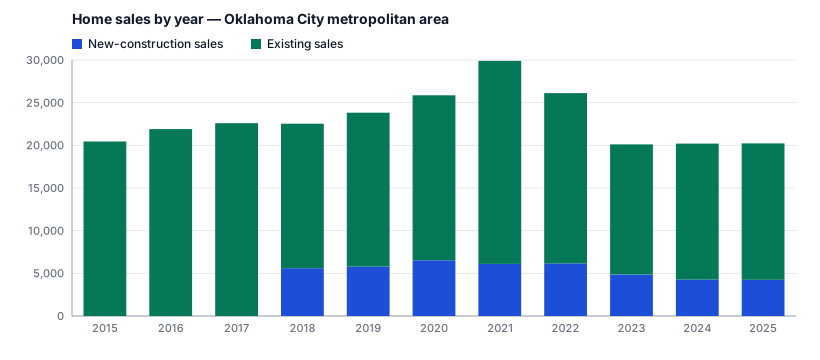
Home-sales totals — Oklahoma City metropolitan area, annual
| Year | New-construction sales | Existing sales | Total |
|---|---|---|---|
| 2016 | — | 21,908 | 21,908 |
| 2017 | — | 22,595 | 22,595 |
| 2018 | 5,599 | 16,939 | 22,538 |
| 2019 | 5,793 | 18,031 | 23,824 |
| 2020 | 6,523 | 19,340 | 25,863 |
| 2021 | 6,105 | 23,790 | 29,895 |
| 2022 | 6,169 | 19,952 | 26,121 |
| 2023 | 4,856 | 15,249 | 20,105 |
| 2024 | 4,266 | 15,937 | 20,203 |
| 2025 | 4,238 | 16,005 | 20,243 |
| 2026 | 549 | 1,980 | 2,529 |
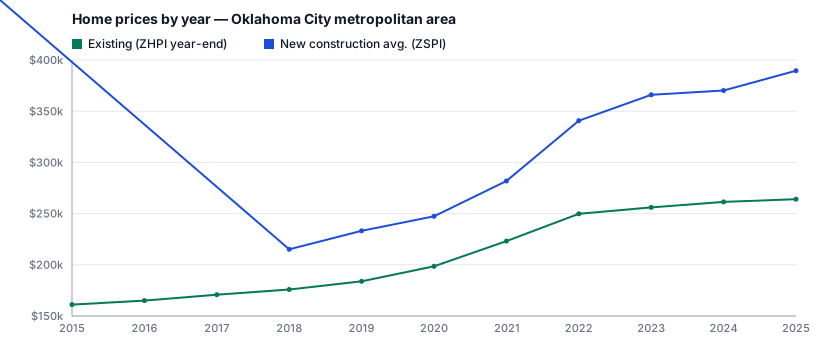
Average sale price — Oklahoma City metropolitan area, annual
| Year | New-construction average | Existing (year-end) |
|---|---|---|
| 2018 | $215,168 | $175,872 |
| 2019 | $233,194 | $183,933 |
| 2020 | $247,374 | $198,494 |
| 2021 | $281,884 | $223,127 |
| 2022 | $340,680 | $249,822 |
| 2023 | $366,058 | $256,099 |
| 2024 | $370,214 | $261,467 |
| 2025 | $389,706 | $264,269 |
| 2026 | $356,153 | — |
Homebuilding and Permits
During 2025, residential building permits in the Oklahoma City, OK metropolitan area totaled 8,218 units, up 1,322 units, or 19.2 percent, from 6,896 units in 2024.
- Single-family homes (1-unit structures) accounted for 6,387 permits during 2025, up 507 units, or 8.6 percent, from 5,880 a year earlier.
- Multifamily structures (5+ units) accounted for 1,241 permits during 2025, up 660 units, or 113.6 percent, from 581 a year earlier.
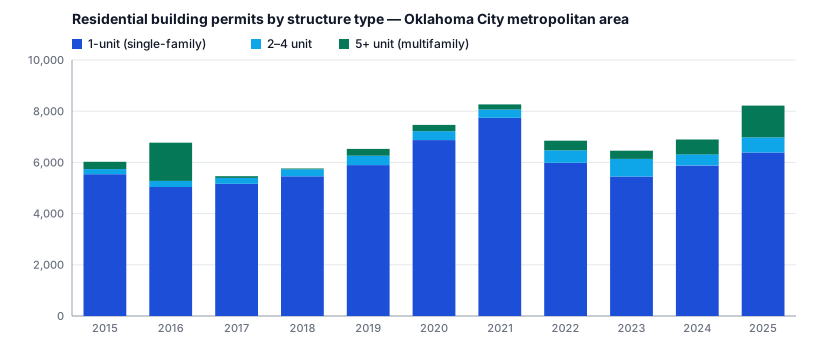
Residential permits — Oklahoma City metropolitan area, annual
| Year | 1-unit (SF) | 2-4 unit | 5+ unit (MF) | Total |
|---|---|---|---|---|
| 2016 | 5,039 | 238 | 1,493 | 6,770 |
| 2017 | 5,167 | 225 | 67 | 5,459 |
| 2018 | 5,456 | 273 | 31 | 5,760 |
| 2019 | 5,895 | 368 | 265 | 6,528 |
| 2020 | 6,873 | 345 | 246 | 7,464 |
| 2021 | 7,743 | 324 | 198 | 8,265 |
| 2022 | 5,982 | 489 | 375 | 6,846 |
| 2023 | 5,449 | 687 | 322 | 6,458 |
| 2024 | 5,880 | 435 | 581 | 6,896 |
| 2025 | 6,387 | 590 | 1,241 | 8,218 |
Source: U.S. Census Bureau, Building Permits Survey (county year-to-date files, coYY12y.txt = full calendar year through December).
Apartment Market Conditions
As of the first quarter of 2026, apartment market conditions in the Oklahoma City, OK metropolitan area are slightly soft, with a 7.0-percent vacancy rate as of February 2026.
- The average rent for all apartments in the Oklahoma City, OK metropolitan area was $1,091 as of March 2026.
- HUD's FY2026 Fair Market Rents for the area are $1,017 for a one-bedroom unit and $1,244 for a two-bedroom unit. The two-bedroom FMR is 14.0-percent above the area's average market rent of $1,091.
- Recent developments include Alley's End with 214 units, located in downtown Oklahoma City, and Residences at Classen Curve with 326 units, offering a mix of unit types focused on upscale urban living.
Rents — Oklahoma City metropolitan area, monthly
| Month | Overall rent | YoY change | Vacancy |
|---|---|---|---|
| 2026-02-01 | $1,081 | -0.2% | 7.0% |
| 2026-01-01 | $1,078 | -0.1% | 7.1% |
| 2025-12-01 | $1,078 | 0.0% | 7.3% |
| 2025-11-01 | $1,087 | 0.3% | 7.4% |
| 2025-10-01 | $1,098 | 0.3% | 7.3% |
| 2025-09-01 | $1,105 | 0.3% | 7.3% |
| 2025-08-01 | $1,109 | 0.8% | 7.1% |
| 2025-07-01 | $1,104 | 1.2% | 6.9% |
| 2025-06-01 | $1,094 | 1.8% | 6.9% |
| 2025-05-01 | $1,092 | 2.5% | 6.6% |
| 2025-04-01 | $1,090 | 2.4% | 6.3% |
| 2025-03-01 | $1,091 | 1.9% | 6.0% |
HUD Fair Market Rents — FY2026
| Bedrooms | 0 | 1 | 2 | 3 | 4 |
|---|---|---|---|---|---|
| Rent | $809 | $1,017 | $1,244 | $1,257 | $1,857 |
Source: HUD User FMR dataset (annual revision).
Location Fundamentals
The standard HUD HMP sections above describe the metropolitan area's housing market itself. This section characterizes the underlying drivers of price formation — safety, schools, natural-hazard exposure, infrastructure, policy, and demographic tailwinds — from Zoomprop's proprietary thematic layers. These signals are the most-replicated non-housing inputs in the hedonic-pricing literature.
The Oklahoma City metropolitan area exhibits several key location fundamentals that may influence home prices. The median school rating of 5.50 suggests moderate educational quality, which can attract families seeking balanced educational opportunities. Hail is identified as the top peril with a score of 93.99, potentially impacting insurance costs and property maintenance considerations. The average walk score of 28.6 indicates limited walkability, which may affect the desirability of certain neighborhoods for those prioritizing pedestrian access. Over the past three years, the population growth rate of 4.1 percent and income growth of 16.5 percent reflect a robust economic environment, likely contributing to increased demand for housing and upward pressure on home prices.
Safety
- Across the Oklahoma City metropolitan area, Zoomprop aggregated 27,769 reported incidents over the most recent six months and 4,435 in the last 30 days.
| Crime type | Last 30 days | Last 6 months |
|---|---|---|
| theft | 793 | 5,360 |
| assault | 606 | 4,172 |
| arrest | 435 | 2,399 |
| burglary | 234 | 1,748 |
| vandalism | 132 | 728 |
- Most recent FBI UCR data for the state (2025) shows a violent-crime offense rate of 22.8 per 100,000 residents and a property-crime offense rate of 89.0 per 100,000 residents.
Source: FBI Uniform Crime Reporting (UCR), state-level, latest full year available.
Schools
- 432 K-12 schools operate within the MSA (24 with GreatSchools ratings).
- Median GreatSchools rating is 5.5 out of 10; 10 schools score 8 or higher and 9 score 3 or lower.
- Average high-school graduation rate is 49.1 percent.
- Average student-to-teacher ratio is 16.8 to 1.
- Average share of students classified as low-income across schools in the MSA is 63.9 percent.
Top-rated schools in the Oklahoma City metropolitan area
| School | City | District | GreatSchools | Grad. rate |
|---|---|---|---|---|
| Harding Fine Arts Academy | Oklahoma City | Harding Fine Arts (Charter) | 10.0 | 95.0% |
| Dove Science Academy Hs | Oklahoma City | Dove Schools Of Okc (Charter) | 10.0 | 99.0% |
| Classen Ms Of Advanced Studies | Oklahoma City | Oklahoma City | 9.0 | — |
| Deer Creek Intermediate School | Edmond | Deer Creek | 9.0 | — |
| Dove Science Academy Middle School South Okc | Oklahoma City | Dove Schools Of Okc (Charter) | 9.0 | — |
Natural-hazard exposure (FEMA National Risk Index)
- Of 419 census tracts in the MSA, 215 (51%) rated Relatively Low; 144 (34%) rated Relatively Moderate; 41 (10%) rated Very Low; 19 (5%) rated Relatively High.
- Leading perils by average FEMA NRI risk score across the MSA's tracts: Hail (score 94.0); Heat Wave (score 84.1); Tornado (score 77.4); Ice Storm (score 74.9); Cold Wave (score 73.2).
- The MSA's tracts average a social-vulnerability index of 48.7 and a community-resilience score of 40.2 (both on FEMA's 0-100 scale).
Source: FEMA National Risk Index, mapped to census tracts and rolled up to the MSA. Flood and wildfire capitalization into home prices is well-documented post-2017 disclosure (Bin & Polasky 2004; Keys & Mulder 2024).
Accessibility & infrastructure
- Across 57 neighborhoods measured, the Oklahoma City metropolitan area has an average Walk Score of 28.6 and an average Bike Score of 33.3.
- 4 neighborhoods score above 70 on Walk Score ("very walkable"); 46 score below 50 ("car-dependent").
- The MSA is served by 3,257 public-transit stops operated by 3 transit agencies across 8 neighborhoods.
Demographic tailwinds
- Population-weighted median household income across the MSA is $67,773.
- Three-year median-income growth averages 16.5 percent.
- Three-year population growth averages 4.1 percent.
- Average neighborhood-level unemployment rate (ACS-derived) is 4.6 percent.
- Average ACS-reported median gross rent is $871.
- Average ACS-reported median owner-occupied home value is $145,646.
Terminology, Definitions, and Notes
Absorption. The net change, positive or negative, in the number of occupied units in a given geographic range.
Building permits. Residential building permits from the U.S. Census Bureau Building Permits Survey (BPS). Permit counts do not necessarily reflect all residential building activity; some units are constructed or created without a building permit, issued under a different permit type, or reported late. Annual totals are aggregated from the county-level full-year file coYY12y.txt (year-to-date through December).
Existing home sales. Includes regular resales and real estate owned (REO) sales.
Home sales / home sales prices. Includes single-family home, townhome, and condominium sales.
Net natural change. Resident births minus resident deaths.
Rental market / rental vacancy rate. Includes apartments and other rental units, such as single-family, multifamily, and mobile homes.
Data Lineage
- Employment (CES supersector): U.S. Bureau of Labor Statistics, BLS Public Data API v2.
- Employment fallback (QCEW county aggregation): U.S. Bureau of Labor Statistics, QCEW Open Data (CSV).
- Unemployment (LAUS): U.S. Bureau of Labor Statistics, LAUS series at MSA / state / national.
- Fair Market Rents: HUD User FMR dataset (ingested into
hud.fmr). - Mortgage rates, delinquency, state HPI: Federal Reserve Economic Data (FRED).
- Building permits: U.S. Census Bureau, Building Permits Survey (annual county files, live fetch).
- Population: U.S. Census Bureau, Population Estimates Program (PEP), vintage CBSA/metro flat files (
cbsa-estYYYY-alldata.csv) with April 1, 2020 decennial base. ACS 5-year estimates are used as a last-resort fallback only. - Narrative color (overview, largest employers, recent developments): Tavily research API, composed by GPT-4 with a fact-check pass against the structured payload.
Location Fundamentals data lineage (Zoomprop proprietary)
- Crime incidents (Zoomprop aggregates): rolled up from local law-enforcement feeds into
public_records.crime_aggregates(rolling 7d / 30d / 6-mo counts per neighborhood). - FBI UCR offense rates:
public_records.fbi_crime_data, state-level, sourced from the FBI Uniform Crime Reporting program. - Schools:
public_records.school, built from NCES Common Core of Data, state DOE files, and GreatSchools ratings. - Natural-hazard exposure:
public_records.weather_risk, mapped from the FEMA National Risk Index (census-tract grain) to the MSA. - Walkability / bikeability:
public_records.walkability(Walk Score / Bike Score per neighborhood). - Public transit:
public_records.transit_stop(GTFS feeds from local agencies, stop-level geometry). - Policy changes:
analysis.policy_changes, curated from municipal / county planning department disclosures. - Development pipeline:
analysis.development_pipeline, curated from permit disclosures, planning-board agendas, and publicly announced projects. - Neighborhood-level demographics:
market.region_demographics_v2, derived from American Community Survey 5-year estimates, population-weighted to the MSA.